Hinge vs Bumble UK for Women Over 35 – Which One Actually Wins?
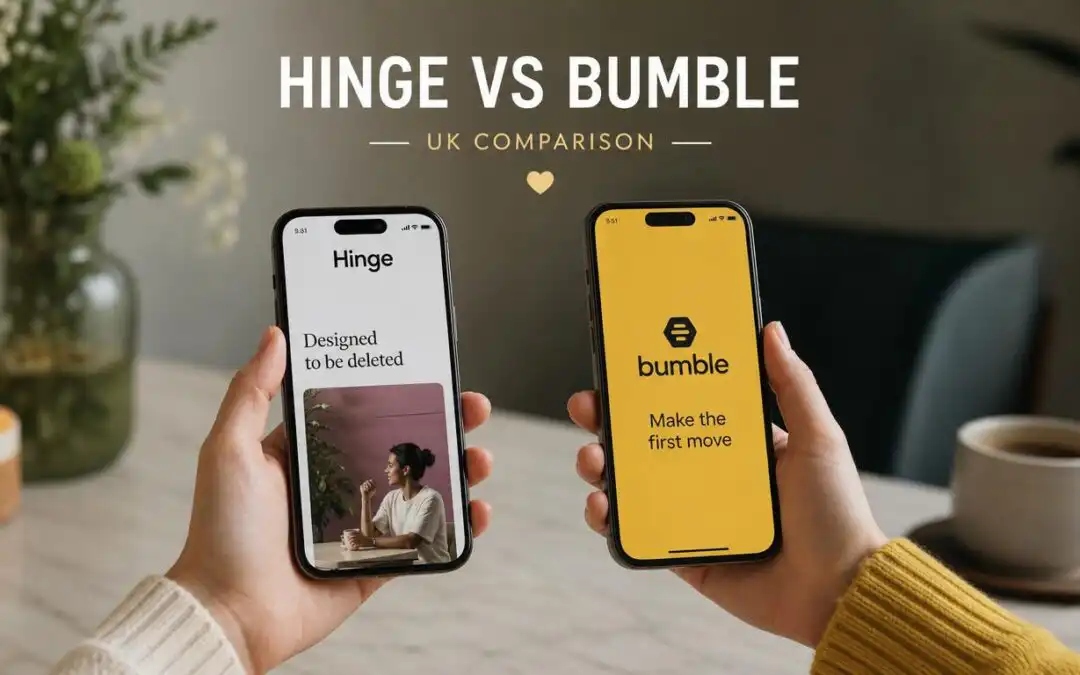
The Hinge vs Bumble UK debate has been running for years and the internet has not exactly covered itself in glory on this one. Most of the comparison articles you will find are either written by someone who used both apps for three weeks and has strong feelings about it, or produced by content teams at companies with a financial interest in you staying on their platform. Neither source is particularly useful if you are a woman over 35 in the UK who wants an honest assessment of which app is actually going to produce better results for your specific situation.
This is that honest assessment. It is informed by over two decades of working with dating companies, coaching clients through both platforms, and watching what actually works for women in their mid-thirties, forties, and beyond in the UK dating market – which is not the same as what works for twenty-six-year-olds in New York, despite what most app comparison content implicitly assumes.
The short answer, if you want it immediately: Hinge. But the longer answer matters, because it explains why – and because there are specific situations where the equation shifts.
KEY TAKEAWAYS
-
The Hinge vs Bumble UK decision looks simple but is not, because the two apps attract different user demographics and reward different profile qualities in ways that matter significantly once you are over 35 and looking for a serious relationship.
-
This post gives you an honest, coaching-informed comparison of both platforms for UK women over 35 – based on two decades of working with 50+ dating companies and coaching real people through both apps, not three weeks of personal testing.
-
Set up profiles on both apps this week and run them in parallel for one month before making a decision – you cannot know which works better for you in your specific location and demographic without actual data from your actual profile.
-
This guide is for any UK woman over 35 who is on the apps, getting mediocre results, and wondering whether she is on the wrong platform or simply needs to change her approach on the right one.
What Hinge and Bumble actually are in 2026
Both apps have evolved considerably from their original propositions, and the versions most people think they know are not quite the versions that exist now.
Hinge launched as “the relationship app” and has largely delivered on that positioning. Its user base skews toward people who are explicitly looking for something serious, its profile format rewards personality and specificity over appearance alone, and its algorithm prioritises engagement – actual conversation – rather than just match volume. In the UK in 2026, Hinge has the most active serious-relationship-seeking demographic of any major app, and that demographic is well-represented in the 30-45 age range.
Bumble launched with a specific differentiator – women message first after a match – designed to reduce the low-quality contact volume that makes many women’s app experiences exhausting. This remains its most distinctive feature and it is genuinely useful. The trade-off is that it requires you to initiate, which filters out the people who want to be pursued and rewards the people who are comfortable being approached.
Why Hinge tends to win for women over 35 in the UK
The profile format is the primary reason. Hinge asks you to answer a series of prompts – short questions that let you show personality, wit, and substance in a way that a photo and a two-line bio cannot. For women over 35 who have interesting lives, genuine personality, and something to say about themselves, this format is an enormous advantage over apps that primarily surface appearance.
The people who get the best results from Hinge are the ones who treat the prompts as a creative writing exercise rather than a form to fill in. A prompt answer that makes someone laugh, think, or want to respond is worth more than a profile that looks technically correct but has nothing distinctive to say. Exactly how to use Hinge prompts to get people to message you is a specific skill that pays dividends across every age group, but particularly for women over 35 who have the life experience to write prompts that are genuinely interesting.
The user intent on Hinge also tends to be clearer. The app’s branding and design explicitly signal relationship intent, which filters the user base in a useful direction. Women over 35 who are looking for a serious relationship are fishing in a pool where a significant proportion of the fish are also looking for a serious relationship – which is not always true of every platform.
Where Bumble has a genuine edge
Hinge vs Bumble UK is not a completely one-sided comparison, and there are specific situations where Bumble performs better.
The women-message-first format is genuinely valuable if you are someone who finds the passive waiting of other apps frustrating. Bumble gives you direct agency – you match, you decide whether to open, you control the pace. For women who are confident initiators and who find Hinge’s slightly more passive dynamic unsatisfying, Bumble’s format suits their approach better.
Bumble also has a larger overall user base in the UK than Hinge, which matters in smaller cities and towns where pool size is a constraint. If you are in a city where Hinge’s active user base is thin, Bumble may simply offer more options even if the average intent is less clearly relationship-focused.
The 24-hour expiry on matches – once you match, you have 24 hours to open or the match disappears – creates a useful efficiency filter. You are not maintaining a long list of matches who will never respond. The matches that survive the 24-hour window have demonstrated some active intent on both sides.
What the profile quality gap looks like in practice
The most consistent thing that over two decades of working with 50+ dating companies has revealed is that app results are far more driven by profile quality than by platform choice. A weak profile on Hinge produces worse results than a strong profile on Bumble. A strong profile on either platform produces dramatically better results than a mediocre profile on the theoretically superior one.
For Hinge vs Bumble UK specifically, this means the following: if your profile is genuinely strong – good photos, interesting prompts, a clear sense of who you are – Hinge will likely outperform Bumble for women over 35. If your profile is mediocre – fine photos, generic prompts, nothing distinctive – neither platform will produce the results you are looking for, and switching between them will not change that.
The highest-value use of your time before making a platform decision is an honest audit of your current profile. Not whether it is acceptable, but whether it is interesting enough to make someone stop scrolling and actually want to know more.
The practical answer
Use both for a month. Set up the strongest possible version of your profile on each, use each platform genuinely, and assess the results. Not just match volume – quality of conversation, quality of the people, quality of the dates that result. One month of real data from your actual profile in your actual location tells you more than any comparison article can.
The pattern that most coaching clients discover is that Hinge produces fewer but higher-quality connections, and Bumble produces more matches with lower average intent. For women over 35 who are looking for a serious relationship rather than volume, that trade-off tends to favour Hinge.
For those who are also considering whether the apps are the right primary approach at all, understanding what introduction services offer as an alternative or complement gives a clear picture of what the more curated end of UK dating looks like.
Hinge vs Bumble UK for women over 35 ultimately comes down to this: Hinge is the better platform if you have a strong profile and clear relationship intent. Bumble is the better platform if you prefer to initiate or if your local pool is larger there. Most women should try both. Most women will find Hinge wins.
Ready to stop guessing and start getting it right?
General advice only goes so far. A personalised coaching session with James Preece gives you a strategy built around your specific situation. With 21+ years behind him, thousands of clients have made exactly this move.
BOOK HERE
.